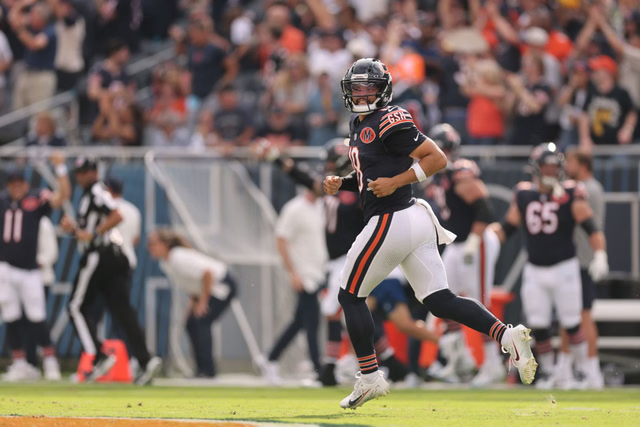
Introduction
The Dallas Cowboys vs Chicago Bears Match Player Stats came into this matchup carrying the weight of championship aspirations and a roster loaded with star power on both sides of the ball. Their season identity has been built around an explosive passing attack, a versatile running game, and a defense capable of forcing turnovers in bunches. Against the Chicago Bears, the Cowboys looked to impose their will early, using tempo and precision to dictate the flow of the game. From the opening drive, Dallas demonstrated confidence in their offensive scheme, spreading the field and challenging Chicago’s secondary with layered route concepts.
Chicago Bears Seek Momentum Through Physical Football
The Dallas Cowboys vs Chicago Bears Match Player Stats entered the contest with a focus on toughness, physicality, and defensive resilience. Their game plan revolved around controlling the line of scrimmage, limiting explosive plays, and relying on disciplined execution to stay competitive. Offensively, Chicago aimed to establish the run early and use play-action passing to create manageable situations. Although the Bears faced challenges against Dallas’ speed and depth, their effort and intensity were evident. Their statistical output reflected a team willing to fight for every yard, even when the scoreboard pressure mounted. Chicago’s ability to move the ball in spurts and generate occasional big plays kept the game competitive for stretches.
First Quarter Statistical Overview
The opening quarter showcased Dallas Cowboys vs Chicago Bears Match Player Stats’ efficiency. Their quarterback completed a high percentage of passes, spreading the ball among multiple receivers. By the end of the first quarter, Dallas had already accumulated over 100 total yards of offense, with a near-even split between passing and rushing yards. Chicago countered with a more conservative approach. Their offense leaned on short passes and inside runs, resulting in modest yardage but limited turnovers. Defensively, the Bears forced Dallas into a couple of third-down situations, though Dallas converted at an impressive rate.
Second Quarter Momentum Shift
In the second quarter, Dallas Cowboys vs Chicago Bears Match Player Stats began to separate statistically. Their passing game became more aggressive, with deeper throws stretching Chicago’s coverage. The Cowboys’ quarterback added another touchdown pass, pushing his first-half stat line toward elite territory. Chicago responded with a sustained drive that showcased their ability to execute methodically. Their quarterback completed several consecutive passes, while the running back added tough yards after contact. Although the drive ended in a field goal, it demonstrated Chicago’s capacity to move the ball against a talented defense.
Halftime Statistical Snapshot
By the break, Dallas Cowboys vs Chicago Bears Match Player Stats had surpassed 250 total yards, with their quarterback throwing for over 180 yards and two touchdowns. Their leading receiver had already crossed the 70-yard mark, and the running back was averaging over four yards per carry. Chicago’s quarterback had accumulated around 120 passing yards, while the ground game accounted for approximately 60 yards. The Bears’ defense had recorded a couple of sacks, preventing the game from becoming lopsided.
Third Quarter Adjustments and Efficiency
The third quarter highlighted Dallas Cowboys vs Chicago Bears Match Player Stats’ ability to adjust. They increased their use of motion and misdirection, creating mismatches that led to chunk gains. Statistically, Dallas added another touchdown drive, featuring both a long pass completion and a red-zone rushing score. Chicago attempted to answer by opening up their offense. Their quarterback took more shots downfield, resulting in one explosive completion that flipped field position. However, inconsistency and pressure limited sustained success.
Fourth Quarter Execution
In the final quarter, Dallas Cowboys vs Chicago Bears Match Player Stats shifted toward ball control. Their running game became the focal point, chewing up clock and adding steady yardage. The Cowboys’ running back finished the game with over 90 rushing yards and a touchdown, while also contributing in the passing game. Chicago continued to fight, producing a late touchdown drive that showcased their resilience. Their quarterback added another passing touchdown, bringing his total to two on the day. Despite this effort, Dallas’ efficiency in earlier quarters proved decisive.
Dallas Quarterback Statistical Performance
Dallas Cowboys vs Chicago Bears Match Player Stats’ quarterback delivered a highly efficient performance, completing over 70 percent of his passes. He finished with more than 280 passing yards, three touchdowns, and zero interceptions. His ability to read coverage and distribute the ball evenly kept Chicago’s defense off balance. Beyond raw numbers, his composure in the pocket and accuracy on third downs stood out. He converted multiple third-and-long situations, extending drives that ultimately resulted in points.
Chicago Quarterback Statistical Performance
Dallas Cowboys vs Chicago Bears Match Player Stats quarterback showed flashes of promise, finishing with approximately 230 passing yards, two touchdowns, and one interception. While he faced constant pressure, he demonstrated toughness and the ability to make plays on the move. His rushing contribution added another dimension, as he scrambled for several first downs. These yards helped Chicago remain competitive and highlighted his dual-threat capability.
Receiving Leaders and Target Distribution
Dallas Cowboys vs Chicago Bears Match Player Stats’ receiving corps enjoyed a productive day. Their top receiver finished with over 110 yards and a touchdown, consistently winning one-on-one matchups. A second receiver added around 80 yards, while the tight end contributed a red-zone touchdown. Chicago’s leading receiver posted close to 90 yards and a touchdown, serving as the primary target in key situations. The Bears’ tight end added around 50 yards, providing a reliable option in the middle of the field.
Rushing Attack Comparison
Dallas’ rushing attack produced over 130 total yards, reflecting a balanced approach. Their lead back accounted for the majority, while a secondary back added change-of-pace carries and a handful of receptions. Chicago’s rushing total hovered around 100 yards. Their primary running back carried the ball 18 times for approximately 75 yards, while the quarterback added scrambling yardage. Dallas’ defense recorded four sacks and forced two turnovers. A standout linebacker finished with 10 tackles and a sack, while a cornerback recorded an interception that shifted momentum in the second half. The defensive line consistently collapsed the pocket, limiting Chicago’s ability to establish rhythm.
Defensive Standouts for Chicago
Chicago’s defense recorded three sacks and forced one fumble. A veteran linebacker led the team with 11 tackles, showing range and physicality. Despite allowing significant yardage, Chicago’s defense made timely plays that prevented the game from becoming a blowout. Dallas won the turnover battle 2-1. Their interception and forced fumble both led to scoring opportunities, a key factor in their victory. Chicago’s lone takeaway resulted in a field goal, highlighting missed opportunities to capitalize fully.
Third-Down Efficiency
Dallas converted over 55 percent of their third-down attempts, a testament to their offensive execution. Chicago converted around 40 percent, respectable but not enough to keep pace. Dallas scored touchdowns on four of five red-zone trips. Chicago scored touchdowns on two of three trips, showing efficiency but fewer opportunities. Dallas controlled the ball for approximately 33 minutes, while Chicago held it for around 27 minutes. This advantage allowed Dallas to dictate tempo.
Special Teams Contributions
Dallas Cowboys vs Chicago Bears Match Player Stats’ kicker was perfect on extra points and added a long field goal. Chicago’s kicker converted two field goals and all extra points. Dallas finished with a higher yards-per-play average and a stronger offensive rating. Chicago’s efficiency improved in the second half but lagged overall. The Cowboys’ numbers highlight a complete team performance. Efficient quarterback play, balanced offense, and disruptive defense combined to produce a convincing statistical edge.
What the Stats Reveal About Chicago
Chicago’s stats show resilience and flashes of potential. Improved consistency and better protection would elevate their offensive output. The interception late in the third quarter, returned deep into Dallas Cowboys vs Chicago Bears Match Player Stats territory, directly led to a Dallas touchdown and effectively sealed the game. Dallas led in total yards, passing yards, rushing yards, third-down efficiency, and turnovers forced. Chicago remained competitive in red-zone efficiency and sacks.
Conclusion
The Dallas Cowboys vs Chicago Bears Match Player Stats tell a story of efficiency versus resilience. Dallas executed at a high level across all phases, showcasing why they are considered contenders. Chicago displayed toughness and moments of promise, but the numbers ultimately favored Dallas Cowboys vs Chicago Bears Match Player Stats’ superior balance and execution.
You May Also Read: Seahawks vs Arizona Cardinals Match Player Stats
