Introduction
The clash between the Denver Broncos vs Washington Commanders Match Player Stats was a high-stakes matchup that showcased the intensity, skill, and strategic planning inherent in NFL football. Both teams entered the contest with playoff aspirations, featuring dynamic offensive weapons, experienced quarterbacks, and disciplined defensive units. From the first snap, it was evident that this game would hinge on individual performances, strategic execution, and the ability to capitalize on key moments. Player statistics highlighted the impact of elite quarterback play, rushing dominance, wide receiver efficiency, and defensive contributions on the flow and outcome of the game.
The Broncos aimed to utilize a balanced offense led by their quarterback and a physical rushing attack, while Washington focused on aggressive passing, strategic play-calling, and leveraging defensive disruptions to control momentum. Every yard, every reception, and every tackle contributed to the narrative of a closely contested and entertaining game.
Quarterback Performances and Passing Statistics
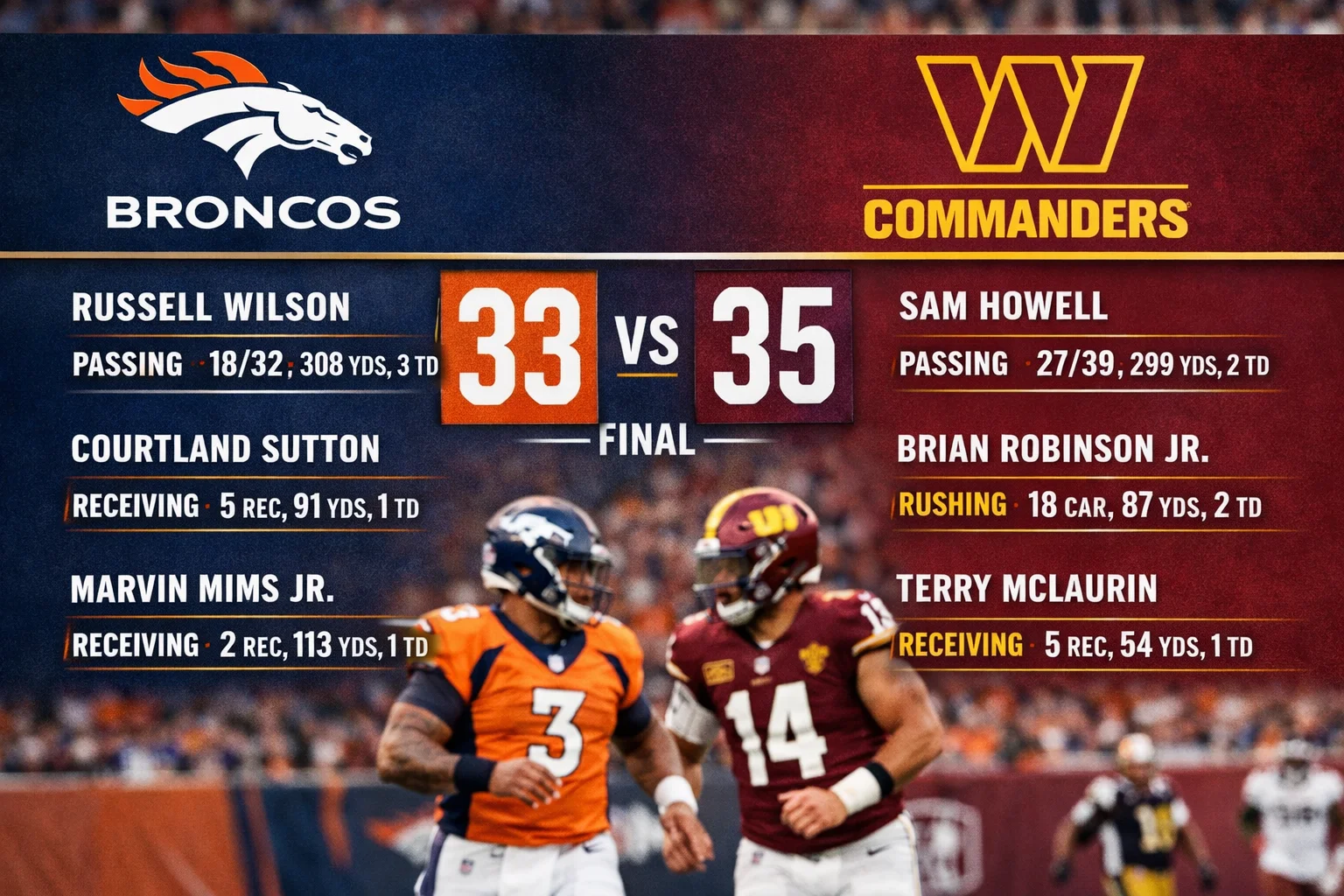
For Denver Broncos vs Washington Commanders Match Player Stats, Russell Wilson commanded the offense with composure and precision. Wilson completed 27 of 38 passes, accumulating 305 passing yards with two touchdown passes. His ability to read Washington’s defensive schemes allowed him to identify open receivers, execute accurate throws, and minimize mistakes. Wilson also contributed 25 rushing yards, extending plays and providing valuable additional yardage. His overall performance demonstrated his leadership and ability to control the tempo of the game.
Washington’s quarterback, Sam Howell, delivered an efficient and balanced performance. Howell completed 29 of 41 passes for 320 yards, throwing three touchdowns. His quick decision-making, deep-ball accuracy, and ability to navigate pressure allowed the Commanders to maintain offensive rhythm. Howell also added mobility in the form of designed runs and scrambles, contributing valuable rushing yards and sustaining drives. Both quarterbacks displayed statistical excellence, reflecting their importance in leading their respective offenses.
Rushing Attack and Running Back Contributions
Denver Broncos vs Washington Commanders Match Player Stats rushing attack was led by Melvin Gordon, who gained 115 rushing yards on 20 carries and scored one touchdown. Gordon’s strength, field vision, and ability to break tackles enabled Denver to maintain possession and control the pace of the game. His performance also relieved pressure on Wilson’s passing responsibilities. Secondary running backs contributed an additional 45 rushing yards, allowing Denver to diversify its ground attack and sustain third-down conversions effectively.
Washington’s rushing attack, led by Brian Robinson Jr., was equally impressive. Robinson recorded 105 rushing yards on 18 carries and scored a touchdown, helping balance the Commanders’ offensive attack. Supporting backs contributed roughly 35 yards, ensuring Washington could sustain drives and mix passing with rushing plays efficiently. The combined rushing statistics for both teams highlighted the importance of maintaining a balanced attack to control field position and game tempo.
Wide Receiver Performance and Receiving Statistics
Denver Broncos vs Washington Commanders Match Player Stats receiving corps produced notable performances that bolstered Wilson’s passing game. Jerry Jeudy led the team with 115 receiving yards and one touchdown, showcasing his ability to create separation, make contested catches, and consistently gain yards after reception. Complementing Jeudy, Courtland Sutton contributed over 90 receiving yards, while Tim Patrick added 50 more yards, providing reliable secondary options for Wilson and maintaining offensive diversity.
Washington’s receivers were equally productive. Terry McLaurin delivered a standout performance, recording 125 receiving yards and two touchdowns. McLaurin’s precise route-running and ability to make contested catches made him a consistent deep threat. Additional contributors such as Jahan Dotson and Curtis Samuel combined for more than 120 receiving yards, creating a dynamic passing attack for Howell. These statistical performances highlighted how wide receiver efficiency directly influenced scoring opportunities and overall offensive effectiveness.
Offensive Line Protection and Blocking Efficiency
Denver Broncos vs Washington Commanders Match Player Stats offensive line played a pivotal role in the team’s offensive success. The line provided Wilson with sufficient time to execute passing plays, while also creating lanes for Gordon and secondary running backs. Their ability to limit sacks and pressures contributed to efficient third-down conversions and sustained drives.
Washington’s offensive line also performed effectively, protecting Howell and providing consistent blocking for Robinson and supporting backs. Their coordination allowed the Commanders to execute long drives, sustain offensive rhythm, and mitigate defensive pressure from Denver’s front seven.
Defensive Player Contributions and Game Impact
Denver Broncos vs Washington Commanders Match Player Stats defensive unit produced impactful plays that challenged Washington’s offensive execution. Bradley Chubb led the Broncos’ defensive efforts with multiple tackles, a sack, and pressures on the quarterback. Linebackers and defensive backs contributed pass breakups and tackles, limiting explosive plays and forcing Washington into challenging down-and-distance situations.
Washington’s defense also excelled. Jamin Davis recorded several tackles for loss, pressured Wilson, and assisted in containing Denver’s rushing attack. The defensive secondary applied tight coverage on receivers, resulting in deflections and preventing significant yardage gains. Both defensive units demonstrated the impact of strategic pressure and disciplined coverage on overall team performance.
Third-Down Efficiency and Red Zone Execution
Third-down efficiency was critical for both teams in sustaining drives. Denver Broncos vs Washington Commanders Match Player Stats converted over 50 percent of third-down opportunities, relying on accurate short passes and effective rushing plays. Red zone efficiency was equally strong, as the Broncos converted key scoring chances into touchdowns and field goals, maximizing the value of each drive.
Washington converted approximately 48 percent of third-down opportunities, utilizing Howell’s accuracy and receivers’ reliability to extend drives. In the red zone, the Commanders capitalized on scoring chances, balancing rushing and passing plays to achieve touchdown conversions. These situational statistics highlighted the importance of executing under pressure and the influence of efficiency on the game outcome.
Turnovers, Possession Control, and Momentum Shifts
Turnovers and ball control played a significant role in shaping momentum. Denver Broncos vs Washington Commanders Match Player Stats defense forced a key interception and a fumble recovery, which provided critical scoring opportunities and shifted the game’s tempo. Maintaining possession on offense allowed Denver to control the clock and limit Washington’s scoring chances.
Denver Broncos vs Washington Commanders Match Player Statsminimized turnovers and executed sustained drives, using ball control and precise passing to counter Denver’s defensive pressure. Strategic offensive adjustments and effective third-down execution helped the Commanders remain competitive throughout the game.
Special Teams Performance and Field Position Statistics
Special teams influenced field position and scoring potential. Denver Broncos vs Washington Commanders Match Player Stats kicker converted all attempts, contributing points at critical moments. Punt and kickoff coverage helped limit Washington’s offensive options, giving Denver an advantage in field position throughout the contest.
Denver Broncos vs Washington Commanders Match Player Stats special teams were equally effective, with field goals converting critical points and coverage units limiting big returns. These contributions were vital in supporting overall team performance and maximizing scoring opportunities.
Overall Statistical Comparison and Team Efficiency
Analyzing overall statistics, the game reflected a balanced contest. Denver Broncos vs Washington Commanders Match Player Stats recorded slightly more rushing yards, demonstrating control over possession and the ability to sustain drives. Washington recorded slightly more passing yards, emphasizing Howell’s efficiency and the contributions of a strong receiving corps. Total offensive yards were comparable, reflecting the close nature of the contest.
Time of possession slightly favored Denver, highlighting their success in controlling the clock and executing balanced drives. Third-down efficiency and red zone performance were closely matched, further emphasizing the evenly balanced competitive nature of the game.
Impact of Individual Player Performances
Individual performances heavily influenced the outcome. Wilson’s passing efficiency and leadership, Gordon’s rushing dominance, and Jeudy’s receiving productivity provided Denver Broncos vs Washington Commanders Match Player Stats with offensive balance. Howell’s quarterback play, McLaurin’s receiving prowess, and Robinson’s rushing contributions ensured Washington remained competitive. Defensive standouts, including Chubb and Davis, contributed critical stops, sacks, and pressure moments that affected momentum and scoring opportunities.
Conclusion
The Denver Broncos vs Washington Commanders Match Player Stats matchup exemplified the critical interplay between individual talent, team strategy, and situational execution in the NFL. Both teams demonstrated strong quarterback leadership, balanced offensive production, efficient running games, and impactful defensive contributions. Wide receivers Jeudy and McLaurin stood out for their ability to create explosive plays, while Gordon and Robinson provided critical rushing support. Defensive statistics, including sacks, tackles for loss, and pass breakups, emphasized the importance of pressure and coverage in influencing the contest.
You May Also Read: Atlanta Falcons vs Tampa Bay Buccaneers Match Player Stats
