Introduction
The matchup between the Green Bay Packers vs New York Giants Match Player Stats delivered a compelling interconference contest defined by precise quarterback play, dynamic receiving threats, and resilient defensive efforts. Green Bay approached the game with a balanced offensive strategy, leveraging quarterback mobility and explosive passing plays to challenge New York’s defensive front. Conversely, the Giants emphasized controlled drives, utilizing both the rushing attack and intermediate passing to sustain possession and create scoring opportunities. The statistical narrative of the game highlights how individual player performances, including passing yardage, rushing output, third-down conversions, red-zone efficiency, and turnovers, influenced the flow and final outcome of this closely contested matchup.
First Quarter Offensive Rhythm and Early Scoring Drives
The opening quarter saw both teams attempting to establish tempo and test each other’s defensive schemes. Green Bay Packers vs New York Giants Match Player Stats relied on short, precise passes complemented by inside runs to sustain early drives. Quarterback Aaron Rodgers efficiently converted a third down with a 14-yard completion to wide receiver Christian Watson, culminating in an early field goal. The Giants responded with a methodical 8-play drive led by quarterback Daniel Jones, mixing short passes to tight end Darren Waller with handoffs to running back Saquon Barkley, resulting in a touchdown. Time of possession was nearly even, but early efficiency on third downs and explosive passing plays provided a slight advantage to Green Bay.
Aaron Rodgers’ Passing and Efficiency Metrics
Aaron Rodgers delivered a precise performance, Green Bay Packers vs New York Giants Match Player Stats completing 27 of 38 passes for 312 yards, 3 touchdowns, and 1 interception. Rodgers averaged 8.2 yards per attempt, demonstrating accuracy on both intermediate and deep routes. His 36-yard touchdown pass to Christian Watson in the second quarter highlighted his ability to read the defense and exploit coverage mismatches. Rodgers also contributed 21 rushing yards on three scrambles, extending plays and converting key third-down situations. His passer rating exceeded 108, reflecting composure and efficiency despite persistent pressure from the Giants’ front seven.
Packers Receiving Corps and Target Distribution
Christian Watson led Green Bay Packers vs New York Giants Match Player Stats receiving unit with 8 receptions for 121 yards and 1 touchdown, consistently creating separation on vertical routes. Wide receiver Allen Lazard contributed 6 receptions for 84 yards, providing a reliable intermediate target. Tight end Robert Tonyan added 5 receptions for 47 yards, complementing the passing attack in red-zone and third-down situations. Collectively, the Packers’ receivers generated over 300 yards, demonstrating balanced distribution, route precision, and situational effectiveness.
Packers Rushing Attack and Offensive Balance
Aaron Jones carried the ball 18 times for 91 yards and 1 touchdown, adding 4 receptions for 36 yards. Jones’ versatility allowed Green Bay Packers vs New York Giants Match Player Stats to maintain a balanced offensive approach, mixing inside power runs with outside zone schemes. His 24-yard run in the third quarter set up a scoring opportunity, keeping the Packers competitive and forcing New York’s linebackers into challenging coverage assignments. The combination of Rodgers’ passing and Jones’ rushing provided Green Bay with a multi-dimensional offensive attack.
Daniel Jones’ Performance and Passing Efficiency
Daniel Jones led the Green Bay Packers vs New York Giants Match Player Stats’ offense with determination, completing 25 of 37 passes for 287 yards, 2 touchdowns, and 2 interceptions. Jones averaged 7.8 yards per attempt and demonstrated mobility, rushing for 28 yards on six carries. His first touchdown pass came on a well-executed play-action to tight end Darren Waller, while a second-quarter connection to Wan’Dale Robinson extended a sustained drive. Despite his effective yardage and leadership, two late interceptions disrupted potential scoring drives and shifted momentum in Green Bay’s favor.
Giants Receiving Leaders and Offensive Output
Wide receiver Wan’Dale Robinson recorded 7 receptions for 96 yards and 1 touchdown, utilizing speed and route precision to generate explosive plays. Darren Waller added 6 receptions for 74 yards, providing a reliable target in intermediate and red-zone scenarios. Sterling Shepard contributed 5 catches for 53 yards, helping maintain offensive balance and keeping Green Bay Packers vs New York Giants Match Player Stats defense honest. Collectively, New York’s receivers produced over 300 yards, demonstrating competitive execution despite facing consistent defensive pressure from the Packers.
Giants Rushing Contributions
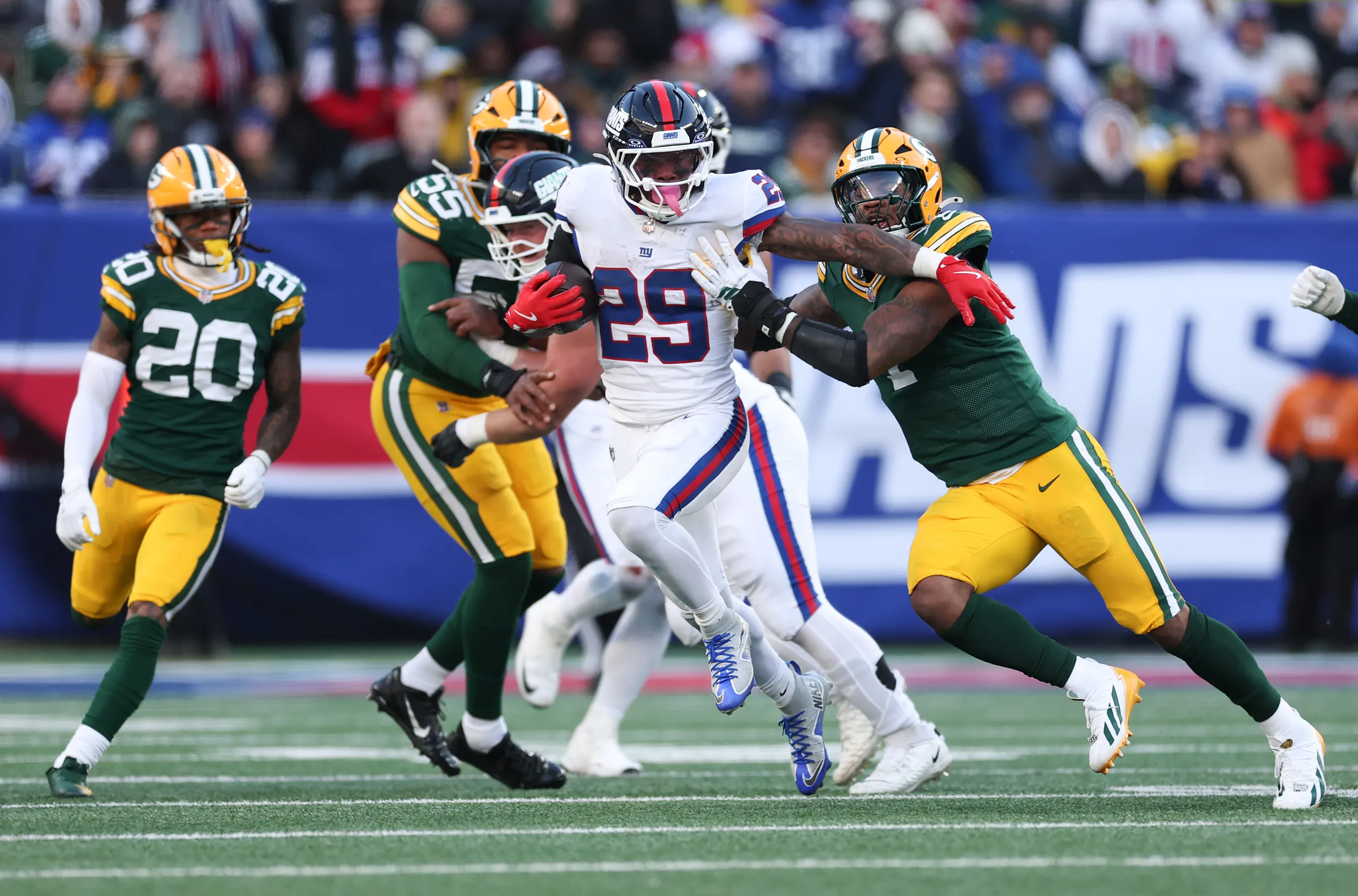
Saquon Barkley rushed for 88 yards on 17 carries and added 5 receptions for 42 yards. Barkley’s combination of power, agility, and vision allowed the Giants to sustain drives and create favorable down-and-distance situations. His 27-yard run in the second quarter set up a scoring opportunity, contributing significantly to New York’s ball-control approach. The dual-threat of passing and rushing enabled the Green Bay Packers vs New York Giants Match Player Stats to remain competitive despite Green Bay’s early explosive plays.
Defensive Performances and Pressure Statistics
Green Bay’s defense generated three sacks and six quarterback hits, with linebacker De’Vondre Campbell recording 10 tackles and 1 sack. Safety Jordan Whitehead contributed eight tackles and a key interception, disrupting a Giants drive in the red zone. The Green Bay Packers vs New York Giants Match Player Stats’ defensive line applied consistent pressure on Jones, forcing hurried throws that led to turnovers. New York’s defense produced two sacks and four quarterback hits, with linebacker Kayvon Thibodeaux registering 9 tackles and a sack, challenging Rodgers and slowing down the passing game at key moments.
Third-Down Conversions and Time-of-Possession Metrics
Green Bay converted 9 of 16 third-down attempts, reflecting effective execution in high-pressure situations. The Giants converted 7 of 14, remaining competitive but slightly less efficient. Time of possession was nearly even, with Green Bay Packers vs New York Giants Match Player Stats holding the ball for 31 minutes and New York for 29 minutes. Sustained drives in the second half allowed both teams to control tempo, but Green Bay’s efficiency on third downs created manageable opportunities for continued offensive production.
Red-Zone Efficiency and Turnover Analysis
Red-zone performance was critical in determining scoring outcomes. Green Bay Packers vs New York Giants Match Player Stats converted 4 of 5 trips into touchdowns, while New York converted 3 of 4. The Packers capitalized on a turnover late in the third quarter to score from short field position, demonstrating the importance of situational execution. The Giants’ two interceptions limited potential scoring drives and contributed to a slightly unfavorable turnover margin. These statistical factors were decisive in maintaining Green Bay’s edge during pivotal moments.
Fourth-Quarter Execution and Clutch Statistics
In the final quarter, Green Bay maintained composure with a 10-play, 68-yard drive culminating in a touchdown pass to Watson, extending the lead and consuming crucial clock time. The Green Bay Packers vs New York Giants Match Player Stats attempted a late comeback, with Jones connecting to Robinson for a 28-yard score, but a failed fourth-down conversion curtailed momentum. Statistical analysis in the fourth quarter highlighted Green Bay’s efficiency, averaging 6.5 yards per play compared to New York’s 5.2, illustrating the Packers’ superior execution in high-leverage situations.
Advanced Metrics and Statistical Insights
Advanced analytics reinforce Green Bay Packers vs New York Giants Match Player Stats slight advantage in efficiency. The Packers averaged 6.3 yards per play overall, compared to New York’s 5.8. Rodgers’ adjusted completion percentage exceeded 73 percent, while Jones’ adjusted rate was approximately 70 percent. Green Bay’s pressure rate forced hurried throws in critical sequences, contributing to turnovers and short-field scoring opportunities. Early-down success rates also favored the Packers, creating manageable third-down situations and sustained drives. Although total yardage was comparable, marginal advantages in efficiency, third-down execution, and situational playmaking allowed Green Bay to maintain a competitive edge.
Conclusion
The Green Bay Packers vs New York Giants Match Player Stats matchup underscored the importance of quarterback efficiency, balanced offensive production, and situational execution in determining NFL outcomes. Aaron Rodgers’ 312-yard, three-touchdown performance, supported by Christian Watson’s explosive receiving and Aaron Jones’ balanced rushing, enabled Green Bay to sustain offensive rhythm and capitalize on key opportunities. Daniel Jones and Saquon Barkley delivered competitive performances for New York, maintaining yardage and offensive balance, but turnovers and red-zone inefficiencies ultimately limited their ability to secure a comeback. The detailed player statistics reveal a closely contested game in which marginal advantages in execution and situational efficiency translated into critical scoring separation, demonstrating how precision, composure, and versatility determine success at the professional level.
You May Also Read: Pittsburgh Steelers vs Chargers Match Player Stats
