Introduction
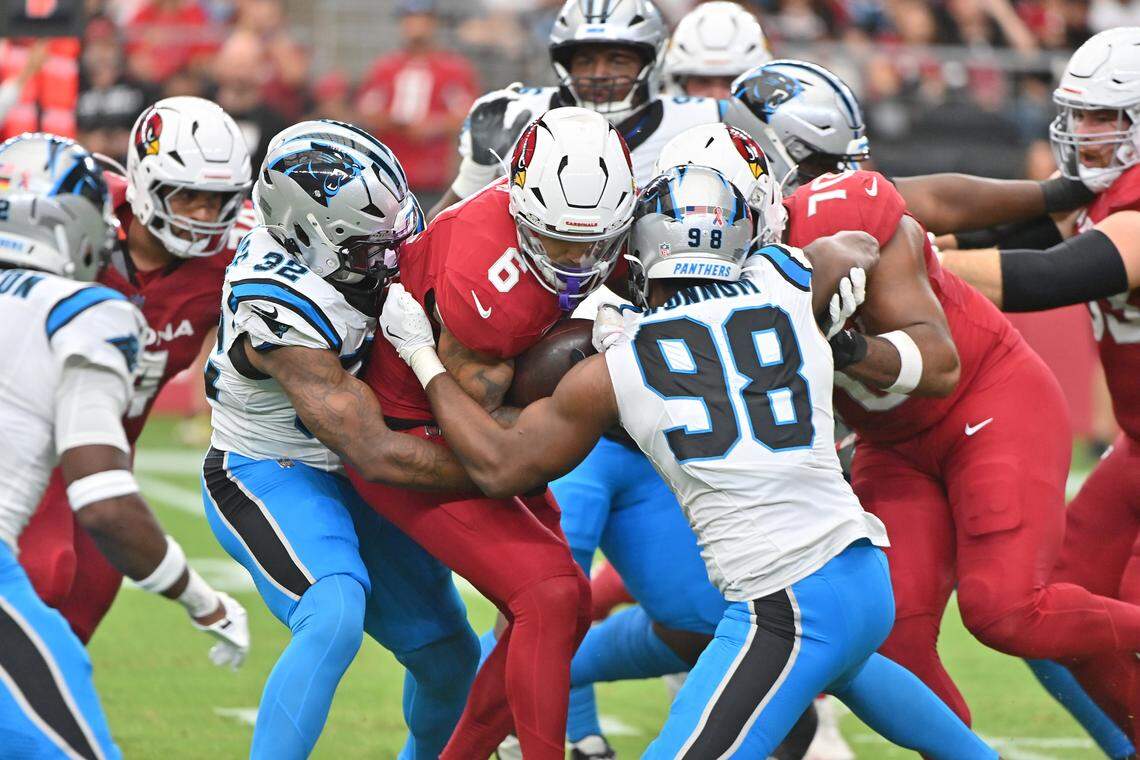
The matchup between the Carolina Panthers vs Arizona Cardinals Match Player Stats was an intense NFC clash that highlighted contrasting offensive approaches and strategic defensive schemes. Carolina entered the game emphasizing a balanced attack, combining a powerful rushing game with efficient passing to maintain tempo, while Arizona relied on a high-octane passing offense led by a mobile quarterback and explosive wide receiver threats. The game’s statistical narrative emphasizes how individual player performances shaped momentum, scoring drives, and ultimately the final outcome. Key metrics such as passing yardage, rushing production, red-zone efficiency, third-down conversions, and turnovers provide a detailed understanding of both teams’ execution and critical contributions from standout athletes.
First Quarter Offensive Flow and Early Momentum
The opening quarter saw both teams seeking to establish rhythm. Carolina Panthers vs Arizona Cardinals Match Player Stats implemented a balanced approach, mixing inside and outside runs with intermediate passing to test Arizona’s defensive front. Quarterback Bryce Young efficiently converted a third down with a 12-yard pass to wide receiver D.J. Moore, culminating in a 6-play, 62-yard drive that resulted in an early touchdown. Arizona responded with a methodical drive led by quarterback Kyler Murray, combining quick passes to DeAndre Hopkins and Marquise Brown while mixing in designed quarterback runs, ultimately settling for a field goal after Carolina’s defensive pressure disrupted a potential touchdown attempt. Early time-of-possession metrics were nearly balanced, though Carolina’s initial explosive plays provided a slight momentum advantage.
Bryce Young’s Passing and Dual-Threat Performance
Bryce Young delivered a composed performance, Carolina Panthers vs Arizona Cardinals Match Player Stats completing 26 of 39 passes for 291 yards, 2 touchdowns, and 1 interception, while rushing for 34 yards on six carries. Young’s mobility allowed him to extend plays under pressure and convert critical third downs. A 36-yard touchdown pass to D.J. Moore in the second quarter exemplified his arm strength and accuracy on vertical routes, while a red-zone completion to tight end Ian Thomas in the third quarter added another score. Young’s poise in both passing and rushing situations made him a central figure in Carolina’s offensive success.
Panthers Receiving Corps and Target Efficiency
D.J. Moore led Carolina Panthers vs Arizona Cardinals Match Player Stats receiving corps with 9 receptions for 115 yards and 1 touchdown, consistently gaining separation and converting key third downs. Robbie Anderson contributed 6 receptions for 84 yards, providing intermediate route precision, while tight end Ian Thomas added 5 receptions for 53 yards and a touchdown in red-zone situations. Collectively, the Panthers’ receivers accounted for over 300 yards, complementing Young’s dual-threat performance and maintaining offensive balance throughout the contest.
Panthers Rushing Attack and Offensive Balance
Christian McCaffrey carried the ball 18 times for 92 yards and 1 touchdown while adding 4 receptions for 38 yards. McCaffrey’s inside and outside running, combined with his receiving ability, kept Carolina Panthers vs Arizona Cardinals Match Player Stats defense off balance and contributed to sustained drives. A 28-yard rush in the third quarter set up a scoring opportunity, demonstrating the effectiveness of Carolina’s balanced offensive approach. The combination of Young’s passing, McCaffrey’s rushing, and versatile receiving options allowed Carolina to maintain a dynamic attack.
Kyler Murray’s Passing and Mobility Metrics
Kyler Murray completed 28 of 40 passes for 314 yards, 3 touchdowns, and 1 interception while rushing for 41 yards on five carries. Murray’s mobility was a key factor in Carolina Panthers vs Arizona Cardinals Match Player Stats offensive strategy, extending plays and converting critical third downs. A 33-yard touchdown pass to DeAndre Hopkins in the first quarter energized the offense, while a 28-yard scoring connection to Marquise Brown in the second quarter kept Arizona within striking distance. Murray’s ability to improvise under pressure and his dual-threat capabilities challenged Carolina’s defensive coverage consistently throughout the game.
Cardinals Receiving Leaders and Target Distribution
Wide receiver DeAndre Hopkins recorded 8 receptions for 122 yards and 1 touchdown, using precise route running and strong hands to create explosive plays. Marquise Brown contributed 7 receptions for 101 yards and 1 touchdown, stretching the field vertically and forcing Carolina Panthers vs Arizona Cardinals Match Player Stats secondary to adjust coverage. Tight end Zach Ertz added 5 receptions for 47 yards, providing a reliable option in third-down and red-zone situations. Collectively, the Cardinals’ receiving corps generated over 300 yards, demonstrating balanced distribution and consistent offensive execution despite Carolina’s pressure.
Cardinals Rushing Contributions
James Conner carried the ball 16 times for 86 yards and added 3 receptions for 22 yards. Conner’s physical running style complemented Murray’s dual-threat ability, helping Arizona sustain drives and convert early-down situations. A 24-yard run in the third quarter set up a scoring opportunity, highlighting the effectiveness of the Carolina Panthers vs Arizona Cardinals Match Player Stats’ rushing attack in controlling tempo and maintaining offensive balance.
Defensive Standouts and Pressure Statistics
Carolina’s defense generated three sacks and seven quarterback hits, with defensive end Brian Burns recording 1.5 sacks and multiple tackles for loss. Linebacker Shaq Thompson tallied 11 tackles, including a key sack, while safety Jeremy Chinn added 8 tackles and forced a turnover in the red zone. Carolina Panthers vs Arizona Cardinals Match Player Stats defense contributed two sacks and five quarterback hits, with linebacker Isaiah Simmons recording 9 tackles and a sack. Both defensive units forced turnovers, applied consistent pressure, and limited explosive plays, keeping the game competitive throughout each quarter.
Third-Down Conversions and Time-of-Possession Metrics
Carolina converted 8 of 15 third-down attempts, reflecting effective situational execution. Arizona converted 7 of 14, remaining competitive but slightly less efficient. Time of possession was nearly balanced, with Carolina holding the ball for 31 minutes compared to Carolina Panthers vs Arizona Cardinals Match Player Stats 29 minutes. Sustained drives allowed Carolina to control the clock and manage tempo, particularly in the second half, while Arizona relied on explosive plays to maintain competitiveness.
Red-Zone Performance and Turnover Analysis
Red-zone efficiency proved pivotal in shaping scoring opportunities. Carolina converted 4 of 5 trips into touchdowns, while Arizona converted 3 of 4, settling for a field goal on one occasion. Carolina Panthers vs Arizona Cardinals Match Player Stats capitalized on an interception late in the third quarter to score from short-field position. Arizona’s lone turnover similarly resulted in favorable field position for the Panthers, demonstrating how marginal advantages in high-leverage situations directly influenced the scoreboard.
Fourth-Quarter Execution and Clutch Performance
In the final quarter, Carolina maintained composure, orchestrating a 9-play, 65-yard scoring drive culminating in a touchdown pass from Young to McCaffrey. Carolina Panthers vs Arizona Cardinals Match Player Stats attempted a late-game comeback, with Murray connecting with Brown for a 27-yard touchdown, but a failed fourth-down conversion curtailed momentum. Statistical trends in the fourth quarter favored Carolina, who averaged 6.4 yards per play compared to Arizona’s 5.3, demonstrating more efficient execution in high-pressure situations.
Advanced Metrics and Statistical Insights
Advanced analytics highlight Carolina’s slight edge in efficiency. The Carolina Panthers vs Arizona Cardinals Match Player Stats averaged 6.2 yards per play overall, compared to Arizona’s 5.8. Bryce Young’s adjusted completion percentage exceeded 72 percent, while Kyler Murray’s stood at 70 percent. Carolina’s pressure rate disrupted key Cardinals dropbacks, forcing hurried throws and contributing to turnovers. Early-down success rates also favored the Panthers, allowing for manageable third-down situations and sustained drives. Despite relatively close total yardage, Carolina’s situational efficiency created a decisive advantage in critical moments.
Conclusion
The Carolina Panthers vs Arizona Cardinals Match Player Stats matchup underscored the importance of quarterback efficiency, balanced offensive production, and situational execution in determining NFL outcomes. Bryce Young’s 291-yard, two-touchdown performance, supported by Christian McCaffrey’s dual-threat rushing and reliable receiving corps, enabled Carolina to sustain offensive rhythm and capitalize on key opportunities. Kyler Murray and DeAndre Hopkins delivered competitive performances for Arizona, maintaining yardage and explosive potential, but turnovers and marginal inefficiencies in the red zone limited their ability to mount a successful comeback. The comprehensive player statistics reveal a closely contested game defined by situational execution and marginal advantages in efficiency, illustrating how composure, versatility, and precision ultimately shape high-level NFL victories.
